

Ginkgo biloba
‘Goldspire™’, ‘Grindstone’, and ‘Sky Tower™’
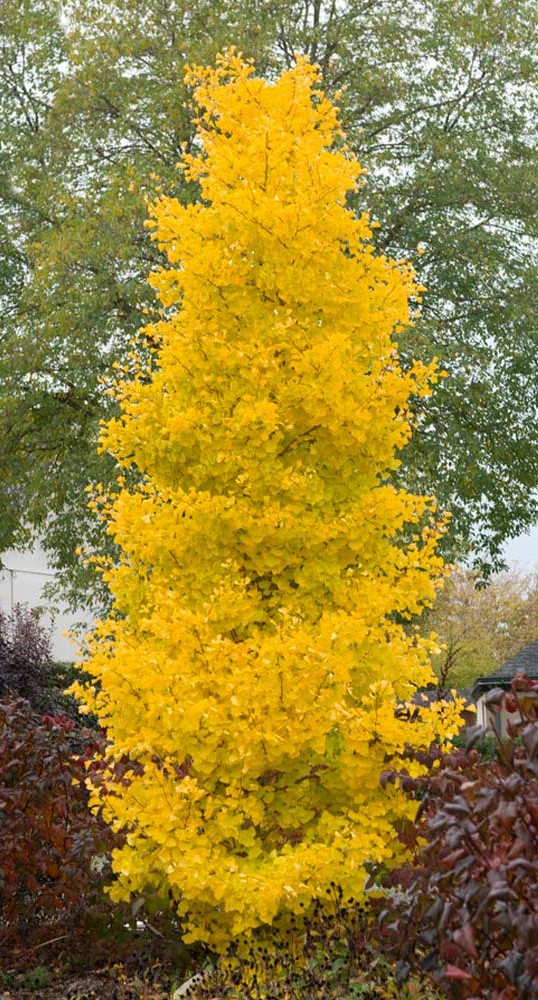
There is likely no tree more recognized or bullet-proof on the planet than the Ginkgo tree, and for good reason. It was here before the dinosaurs roamed the Earth, survived the Pleistocene glaciation period, was found later in a restricted area of China, and now a living fossil that we still enjoy. Not surprisingly, in our search for the perfect urban tree, the ginkgo has always been in the running. Why? Because they are tolerant of a wide range of temperatures, will grow in most any soil, are tolerant of air pollution, drought, freezing temperatures, fire, heavy metals, low salt levels, and ozone. In addition, the fan shaped leaf is beautiful, like no other, and the fall yellow color is spectacular! The literature notes susceptibility to stem rot and leaf blight but is seldom seen.
Personally, the Ginkgo tree has always been one of my favorite urban trees, but frustratingly slow to grow. Urban Foresters were always warned to plant only the male, as the smell of the female fruit can be so disgusting. The industry directs us to grow only male cultivars to avoid the fruit. However, from research and my own experience, males periodically have the ability to send out a limb that produces fruit. I personally have witnessed Princeton Sentry Ginkgo cultivars, in our nursery, at the Morton Arboretum, and other locations, all presumably confirmed male clones, but with an occasional fruit. Remember the great line in the Jurassic Park movie, “Nature finds a way”. It is no wonder that Ginkgo trees have survived for millions of years.
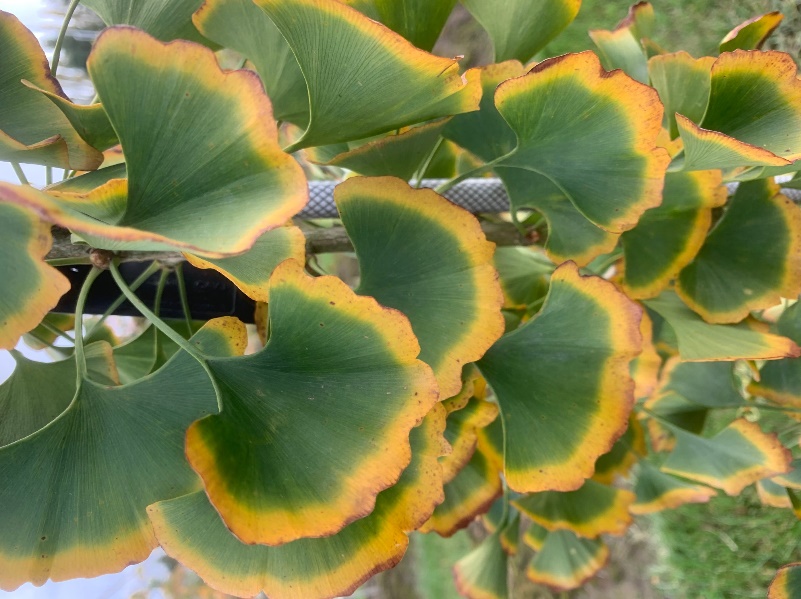
While growing many common Ginkgo male cultivars, including Princeton Sentry, Autumn Gold, Golden Colonnade®, Magyar, Presidential Gold®, and others, we have not always seen the uniformity that we expect and see in other species cultivars. Although Presidential Gold® has been the most promising of this group. Is it possible that they lack a strong gene trait to influence the characteristics of these selections, or is the original morphology of the seedling Ginkgo so strong that the tree is trying to grow back to its original self?
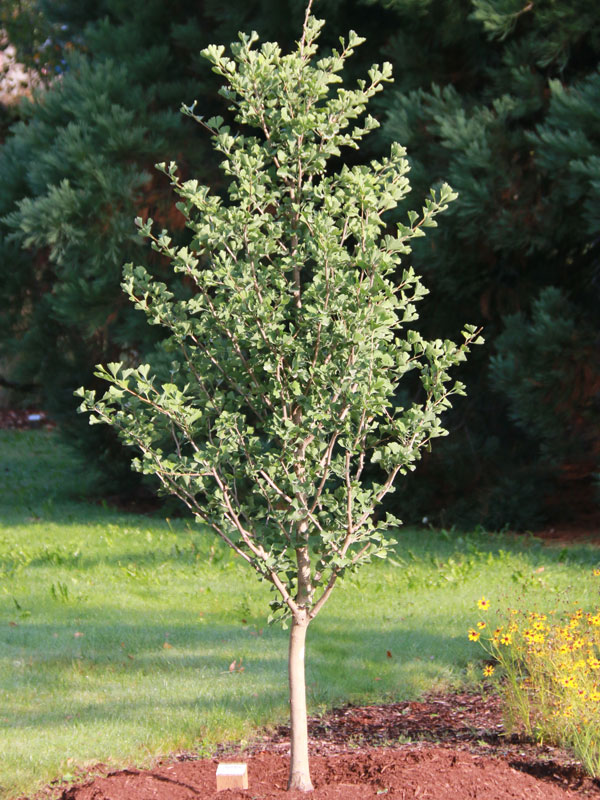
In recent years we have come across other cultivars that show more uniformity of form and structure, specifically ‘Goldspire™’, ‘Grindstone’, and ‘Sky Tower™’ (possibly all the same tree as the literature is confusing). These appear to have the most reliable branch structure for any ginkgo that I have seen, such as branches evenly spaced along a central leader all the way up the stem. Frankly, I was blown away when I first saw these three, compared to other cultivars we have grown,but their ultimate mature size is still in question. The ‘Grindstone’ is a very tall tree, as so well illustrated in an online video. However, the ‘Goldspire™’ is listed to mature at anywhere from 15 to 45 feet. And ‘Sky Tower™’ is said to mature at 15 to 20 feet. Most important is our observation of the evenly space branch structure and more reliable form on these “three” cultivars.
Ginkgos can be frustratingly slow to grow, but the ultimate size may not matter to some. In youth, they have to be staked, as their trunk can be like rubber, and early careful pruning will pay off in its ultimate form. They have a fat, fleshy, prolific root system and transplant well but may take a couple of years to become established. Have patience,they respond well to high nitrogen and regular limestone applications and appear to prefer to grow better in the heat.
As climate changes and new insect and diseases challenges appear, I doubt there will be a better choice than planting a Ginkgo in almost any location.
As always, let me know your experience with these trees.
CLICK HERE FOR MORE TREE PROFILES
Jim Barborinas
Owner of Urban Forest Nursery, Inc.
ISA Certified Arborist #0135
ASCA Registered Consulting Arborist #356
15119 McLean Rd.
Mount Vernon, WA 98273
jim@urbanforestnursery.com
Still curious how Goldspire™, Grindstone, and Sky Tower™ Ginkgo perform in landscapes or urban planting?
Here are some common questions we hear from people considering these trees:
These Ginkgo cultivars each have a distinct mature size and a slow to moderate growth rate. ‘Goldspire™’ is a narrower, upright form that typically matures to around 45 feet tall with a tighter spread. ‘Sky Tower™’ stays more compact and columnar, often reaching roughly 15 to 20 feet tall, making it ideal where space is limited. ‘Grindstone’ is a taller selection — reported to grow quite tall, though exact ultimate height varies with site conditions. In all cases, these Ginkgos establish slowly at first and then grow more steadily over time.
Ginkgo is a standout tree in any landscape, known for its extraordinary history and its fan‑shaped leaves. These particular cultivars are selected for improved structural form — branches are evenly spaced along a strong central leader, giving a cleaner, more reliable shape. They offer the same tough, urban‑ready nature of the species but with refined habit differences that fit a range of landscape situations.
Yes — Ginkgo’s tolerance for pollution, drought, salt, heat, and compacted soils makes it one of the best trees for tough urban conditions. The male cultivars like these avoid messy fruit, and their upright or columnar forms fit well in boulevards, narrow planting strips, or smaller yards where space and reliability matter.
Absolutely — Ginkgo is famous for its bright golden yellow fall color that really stands out. Before that, its unique fan‑shaped leaves provide texture and presence through spring and summer. The seasonal transformation is something gardeners and designers often look forward to year after year.
These Ginkgos are slow to establish and will benefit from proper staking and formative pruning when young to encourage a strong central leader. Once established, they are very low‑maintenance and long‑lived. Good soil drainage and consistent early moisture help get them going, and after that, they reward you with resilience and beauty for decades.