

Syringa reticulata and S. pekinensis
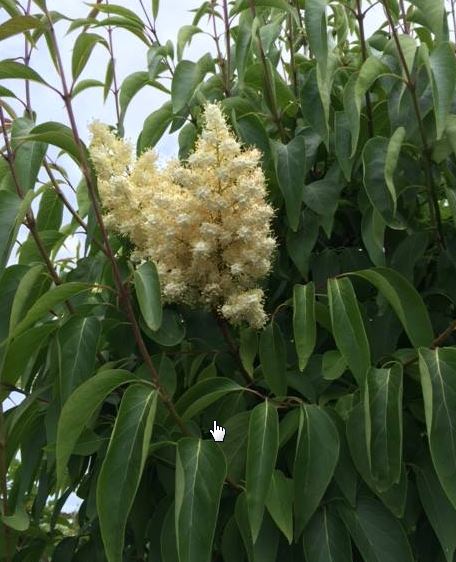
The large and fragrant flower of the common lilac is a fondly held memory and experience for many of us. Most often planted as a shrub, lilacs have also been grown in tree form for some time. However, they are not used as often as they should as a tree. In addition to the more familiar shrub forms, there are tree forms of this plant. As we get better at selecting small maturing trees for use in smaller spaces, tree lilacs Syringa reticulata and S. pekinensis are definitely ones to consider.
Tree lilacs are relatively small, at most about 20 to 30 feet tall and 15 to 25 feet wide. Leaves are opposite, single, entire, broad-ovate, 2 to 5 and half inches long and about half as wide. Leaves are dark green on top and grayish green and reticulate (netlike pattern) on the bottom. The undersides might also be glabrous or slightly pubescent. Spring growth appears to be fresh, clean and balanced. Newly emerging leaves have a wine colored hue, turning green as they expand. Bloom time is early summer. Flowers are white to cream color, born on stalks 6 to 12inches tall and 5 to 8inches wide. I have found them to be fragrant and agreeable while Dirr has noted some smell privet-like, un-appealing to some.
Trunks are for the most part very straight with prefect branch structure at almost a 90 degree angle of attachment before curving upward to form an ascending crown. Twigs and limbs are a bit brittle, somewhat of a concern for shipping or when children like to reach out and grab a limb. A little corrective pruning is beneficial as they age but otherwise are relatively care free trees.
Generally, lilacs can be susceptible to disease and frost injury but the selections are found to be more resistant. Transplanting is relatively easy and they favor loose, well drained soils that are slightly acid, although they are known to be tolerant of a wide pH range. They grow best in full sun and will take some shade. They have good drought tolerance once established, important to consider as our climate changes.
Fortunately, more and improved varieties continue to reach the market. One of the oldest and well known selections is Syringa reticulata ‘Ivory Silk’ introduced in 1973. Others are ‘China Girl’ and ‘Summer Snow’ to name a few lilac trees. Another closely related tree is Syringa pekinensis ‘Summer Charm’. Make a point of requesting these for small planting space locations and you might find them more available.
As always, let me know your experience with this tree.
CLICK HERE FOR MORE TREE PROFILES
Jim Barborinas
Owner of Urban Forest Nursery, Inc.
ISA Certified Arborist #0135
ASCA Registered Consulting Arborist #356
15119 McLean Rd.
Mount Vernon, WA 98273
jim@urbanforestnursery.com
Curious how Lilac Tree performs in landscapes?
Here are some common questions people ask about this tree:
Tree lilacs bring the familiar large, fragrant flowers people love from shrub lilacs, but in a small tree form that can fit in many landscapes. They have clean, balanced spring growth and attractive foliage that starts wine‑colored and turns green as it expands.
Tree lilacs are relatively small, generally reaching about 20 to 30 feet tall with a spread around 15 to 25 feet wide, and they form a mostly straight trunk with a balanced crown.
Early summer brings white to cream flowers on stalks, which many find fragrant and pleasing. Leaves are opposite, dark green on top with grayish‑green undersides, and new spring foliage may show a wine tint as it emerges.
Branches attach at nearly 90° angles before curving upward, giving good structure. Twigs and limbs can be a bit brittle, so light corrective pruning as the tree ages can help. They are generally relatively care‑free once established.
Tree lilacs transplant relatively easily and do well in loose, well‑drained soils. They enjoy full sun but can tolerate some shade, and once established they have good drought tolerance.