

Chamaecyparis nootkatensis
This tree profile is shared for educational purposes. Urban Forest Nursery does not currently grow this variety, but it remains part of ongoing discussions around urban tree selection.
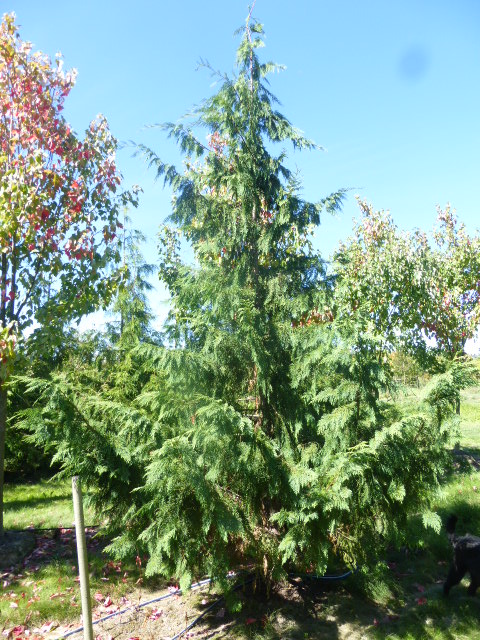
UPDATE 2026: Once again, this is an excellent Alaska Cedar conifer and highly recommended but we do not have enough room to grow them. Although potentially very large, I have seen them limbed up and used as street trees, specifically in downtown Seattle. They can be finicky to transplant especially as B&B. Growbag and airpot grown root systems are the best for a reliable root system. Container stock is also good but be cautious of circling roots.
Alaska-cedar, also called Alaska yellow-cedar, yellow-cedar, Alaska cypress, and Nootka cypress is an important timber species and one of the slowest-growing conifers. Of landscape significance is the fact that it stays green through the winter months when the native red cedar turns a golden reddish brown, enough to make people think they have died. They are also much more fragrant than the red cedar.
Alaska–cedar trees grows from northern California to Prince William Sound, AK Except for a few isolated stands, it is found within 160 km (100 miles) of the Pacific coast. Isolated stands in the Siskiyou Mountains, CA, near the Oregon border mark its southern limit. In Oregon and Washington, Alaska-cedar grows in the Cascade Range and Olympic Mountains; scattered populations are found in the Coast Ranges and in the Aldrich Mountains of central Oregon. In British Columbia and north to Wells Bay in Prince William Sound, AK, it grows in a narrow strip on the islands and coastal mainland.
Alaska-cedar is notable within the cypress family for its tolerance of cool and wet conditions. The climate of its natural range is cool and humid. Climatic conditions at elevations where Alaska-cedar trees grows in the Cascade Range of Washington are somewhat comparable to those at sea level in coastal Alaska.
Let me know if you have any experience with the Alaska Cedar trees.
CLICK HERE FOR MORE TREE PROFILES
Jim Barborinas
Owner of Urban Forest Nursery, Inc.
ISA Certified Arborist #0135
ASCA Registered Consulting Arborist #356
15119 McLean Rd.
Mount Vernon, WA 98273
jim@urbanforestnursery.com
What should I know about Alaska Cedar (Chamaecyparis nootkatensis)?
Here are some common questions we hear from people considering this tree:
Alaska Cedar is still considered an excellent and highly recommended tree, but it is no longer part of our production due to space limitations. Its slow growth rate and large mature size make it more difficult to fit into our current growing program.
This tree is an attractive evergreen conifer that maintains its rich green color through winter, unlike some native cedars that shift to a bronze tone. It is also known for its pleasant fragrance and fine-textured foliage, making it a distinctive choice in the landscape.
Although it can become quite large, Alaska Cedar has been successfully used in urban settings when properly managed, including as a limbed-up street tree. It performs best in cool, moist environments similar to its native range along the Pacific coast.
This species can be somewhat finicky to transplant, especially when grown as balled and burlapped stock. Grow bag and air-pot production methods tend to produce more reliable root systems, while container-grown trees can perform well if care is taken to avoid circling roots.