

Tilia tomentosa
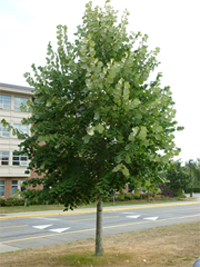
Linden trees, especially American, Tilia Americana and littleleaf, Tilia cordata,have been widely planted in urban areas because they are drought tolerant, durable and beautiful, and thrive is some of our toughest locations. However, aphid infestations on these lindens can be incredibly messy and a real nuisance. The “honey dew” under a street tree can appear as if it rained just beneath the canopy. Except in this case, the shiny area you see is sticky like glue, excretions from the aphids. This glaze of honeydew can be horrible for cars, sidewalks and outdoor furniture.
A perfect solution to avoid this malady is to select a close relative, the silver linden, Tilia tomentosa, which does not attract aphids. As the species name implies tomentosa is used to describe a woolly coating on the leaf formed by the tomentose hairs. Apparently, it is the hairs or woolly coating on the leaves that repel the little critters. So, there is no need to blacklist all lindens because of the aphids.
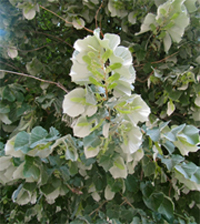
Silver lindens tree can be large, up to 50 or more feet tall and up to two-thirds that width. Cultivars will likely have more limited size and predictable form. ‘Sterling®’, ‘Green Mountain’ and ‘Szeleste’ are possibly the more popular silver lindens selections available.They get their name from the silvery white pubescent underside of the relatively large leaves. A breeze through their crown will give the same effect of wind blowing through an aspen grove. The upper side of the leaf is a bright shiny dark green. Fall colors are not spectacular but a decent yellow like other lindens. The bark is light gray in youth. As it ages, it becomes grayish-brown with deeper furrowed ridges.
The wood is relatively soft, a pleasure, especially when young, to prune. The buds on twigs are fat and flowers are yellowish white and highly attractive to bees. In Europe, where lindens are also known as lime trees, linden honey is highly valued. In our experience, the structure of linden trees can be deceptive; if you see an obvious inclusion between the main leader and lateral limbs, do not assume it is significantly problematic. Consensus among arborists I have discussed this with is that the union may still be relatively strong.
Dirr reports that the silver linden is even more drought tolerant that the other lindens. We find lindens to caliper fast, develop crown slowly and are relatively easy to transplant. Keep your eyes out for any of the silver linden tree selections to put on your new and improved street tree list.
As always, e-mail me additional comments on this tree.
CLICK HERE FOR MORE TREE PROFILES
Jim Barborinas
Owner of Urban Forest Nursery, Inc.
ISA Certified Arborist #0135
ASCA Registered Consulting Arborist #356
15119 McLean Rd.
Mount Vernon, WA 98273
jim@urbanforestnursery.com
Curious how Silver Linden performs in landscapes and streetscapes?
Here are some common questions people ask about this tree:
Silver Linden doesn’t attract aphids like other lindens, thanks to the woolly hairs on its leaves. Its silvery-white leaf undersides shimmer in the breeze, creating a soft, moving texture that adds visual interest throughout the year.
Sterling® grows to about 45 feet tall with a spread of approximately 35 feet. The crown is upright with a strong central leader, and branches develop a graceful, slightly spreading form. Bark matures to grayish-brown with shallow ridges.
Creamy-yellow to white flowers appear in summer and attract bees. Foliage turns a subtle yellow in fall, while the shimmering leaf undersides continue to provide texture and movement.
Silver Linden transplants well, tolerates drought, and is durable in streetscapes. Its strong central leader and moderate growth make it a reliable urban tree.
Branch unions are generally strong, and pruning is easy due to the relatively soft wood. Popular selections like ‘Sterling®’, ‘Green Mountain’, or ‘Szeleste’ maintain consistent form and performance.