

Prunus serrulata ‘Royal Burgundy’
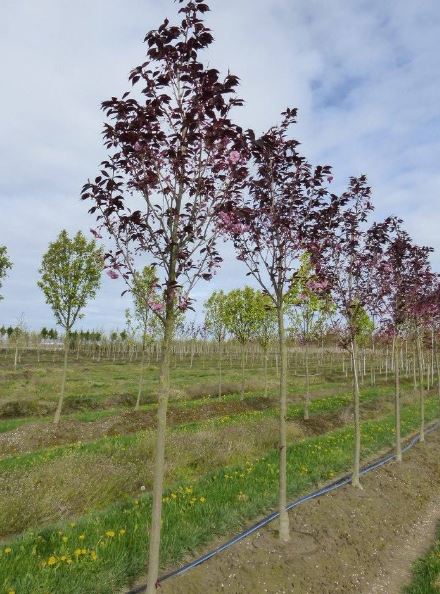
Few ornamental cherry varieties do well in the Pacific Northwest, but the Royal Burgundy flowering cherry tree may be an exception. Similar in form to a kwanzan, it appears to grow at a slower rate. The Royal Burgundy Cherry also seems to have a less aggressive root system and less tendency to develop the large surface roots we sometimes see on grafted cherry trees. The most significance difference however, are the deep dark purple leaves framing the stout light pink double flowers in early spring. Dirr states that this tree was discovered by Frank Parks, Speer and Sons Nursery in Oregon and only patented in 1989. With its rich dark foliage, this tree is a knockout, especially when it is in bloom.
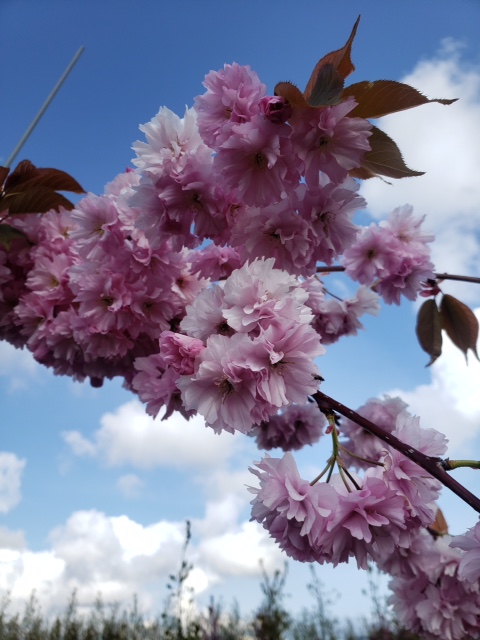
The Royal Burgundy is vase shaped. Select nursery specimens based on what height you want the crown to start. Most cherry varieties are grown from basal bud grafts these days so nurseries can start crown growth at a decent height on a tall liner. Trunks are relatively straight and it has an open branching habit, also good for cherry trees that need as much air circulation as possible to discourage fungal diseases. Leaves are simple, ovate to ovate lanceolate, and 1 ¼ to 2 ½ inches long. They have a lightly serrate edge. The dark reddish purple foliage can turn reddish orange in the fall. The Royal Burgundy Cherry transplants easily, but like all cherries, it should be planted in well drained soils and never be sitting in water.
While discussing this tree with other growers, arborists and landscapers, there is some concensis that there appear to be few insect or disease pests that bother it. This observation and its apparently slower growth make it an excellent tree to consider for street, landscape and garden locations. Let me know if you have had similar or different experiences with the Royal Burgundy Cherry.
I always appreciate any comments you have on this or other varieties you work with.
CLICK HERE FOR MORE TREE PROFILES
Jim Barborinas
Owner of Urban Forest Nursery, Inc.
ISA Certified Arborist #0135
ASCA Registered Consulting Arborist #356
15119 McLean Rd.
Mount Vernon, WA 98273
jim@urbanforestnursery.com
Curious how Royal Burgundy™ Cherry performs in landscapes and street plantings?
Here are some common questions people ask about this tree:
Royal Burgundy™ is notable for its deep dark purple foliage that frames light‑pink double flowers in early spring. The dark leaves and stout blooms give it a striking presence when in full flower, and its open branching habit supports good air circulation around the canopy.
This cherry typically reaches about 20 feet tall with a 15 foot spread, forming a vase‑shaped crown with a relatively straight trunk and open branching. It grows at a slower pace compared with many other cherries, giving you a steady, manageable size in landscapes.
Yes — its less aggressive root system and slower growth make it easier to use near sidewalks, in streetscapes, or in garden settings without the large surface roots often seen on other cherry varieties. Its darker foliage also adds year‑round interest in urban sites.
Absolutely — beyond the abundant pink spring blossoms, the dark reddish‑purple leaves can turn reddish‑orange in fall. The contrast of foliage and flowers gives multi‑season appeal in landscape or street planting.
Royal Burgundy™ transplants easily when placed in well‑drained soil. Like all cherries, it should not sit in water; consistent drainage helps it establish a strong, open structure and maintain health with minimal issues in typical landscape conditions.