

Zelkova serrata
UPDATE 2026: Zelkova trees, especially the cultivars continue to perform well in tough urban sites. Right now, we are growing the ‘Green Vase’, ‘City Sprite®’, and ‘Musashino’ cultivars. The ‘City Sprite®’ cultivar, not mentioned below is especially unique because of its very dense broad crown but maturing still under powerline height. Just make sure you give ‘City Sprite®’ plenty of width.
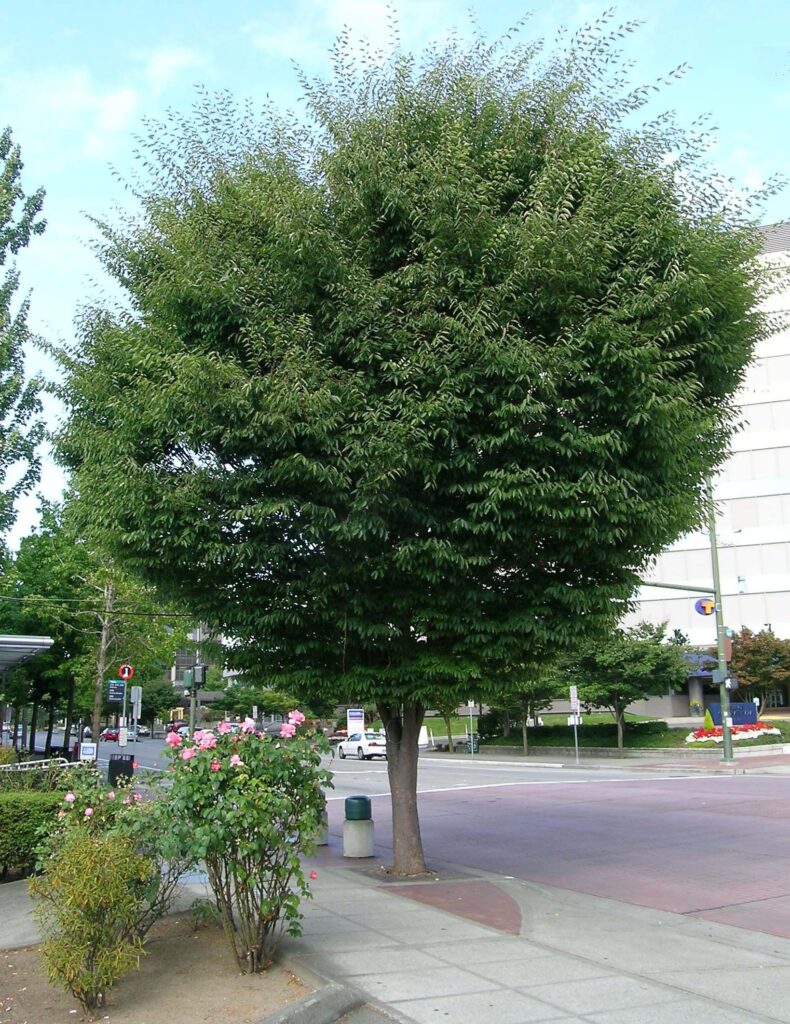
The Japanese Zelkova (Zelkova serrata), and its cultivars, have proven to be a popular and reliable urban tree. Being aware of the differences in the cultivars, and some of the new ones being grown, will help you make the right selection when planting this variety.
The species is fast-growing, somewhat wide-spreading, and vase shaped. The most obvious characteristic of the straight species is the somewhat crooked or curve in some of the limbs compared to most of the other cultivars that have straight limbs.
Thought at first to become a replacement for the magnificent elm, the Zelkova will never live up to that due to its ultimate smaller size. The leaf is similar to an elm leaf, but narrower. The fall color is usually yellow, but sometimes bronzy-reddish during dry falls on the west side of the Cascade Mountains, but more typically richer in color on the east side. I have seen some older Zelkovas with included bark, but that may be avoided when selecting in the nursery. Its susceptibility to Dutch Elm Disease has been in question, but most anecdotal evidence suggests there is some resistance. Although I have observed dieback in stressed trees, it appears that once established, it does perform relatively well in the most inhospitable of sidewalk opening locations. See the Zelkovas around Safeco Field in Seattle, Washington or in downtown Bellevue, Washington.

The most popular cultivars I am aware of are the ‘Halka’, ‘Village Green™’, ‘Musashino’, ‘Wireless®’, and ‘Green Vase®’. ‘Halka’ is the fastest and largest growing Zelkova cultivar, making it the closest Zelkova replacement for the elm, but still falling short. ‘Village Green™’ has a reliable wide-spreading form, with straight limbs and dense green foliage. You must give this tree crown room to spread. The ‘Green Vase®’ Zelkova is a narrower, V-shaped, more upright crown, and an excellent street tree, especially for limited above-ground places with limited width for the crown. The Musashino Zelkova (Zelkova serrata ‘Musashino’) is even narrower than Green Vase®, which should become popular. There is also ‘Wireless®’ Zelkova (Zelkova serrata, ‘Schmidtlow’), which is even more broad-spreading than Village Green™, making it, as the name implies, appropriate for utility wire locations without growing into the wires.
Given the toughness of this tree and variety of forms available, Zelkovas will continue to play an important role in our street tree arsenal. There should be no excuse for not choosing the right Zelkova tree for the right place.
As always, I appreciate any comments on experiences you have had on these and other tree varieties.
CLICK HERE FOR MORE TREE PROFILES
Jim Barborinas
Owner of Urban Forest Nursery, Inc.
ISA Certified Arborist #0135
ASCA Registered Consulting Arborist #356
15119 McLean Rd.
Mount Vernon, WA 98273
jim@urbanforestnursery.com
Curious how Japanese Zelkova performs in landscapes and streetscapes?
Here are some common questions people ask about this tree:
It’s a fast-growing, vase-shaped tree with strong performance in urban and challenging sites. Cultivars vary in crown shape and spread, so selecting the right one helps match the tree to the available space.
The species is wide-spreading and vase-shaped, with some cultivars narrower or more upright than others. Branches of the straight species can be slightly crooked, while cultivars generally have straight limbs, forming a balanced canopy.
Leaves resemble elm leaves but are narrower. Fall color is usually yellow, sometimes bronzy-reddish, adding visual interest to landscapes. Established trees maintain good form in tough urban conditions.
Zelkovas tolerate tough sidewalk openings and stressed sites once established. While some dieback may occur under stress, most perform reliably in urban streetscapes.
Select the right cultivar for your space. Options range from broad-spreading to narrow, upright forms suitable for streets, limited width areas, or near utility lines. Proper siting ensures long-term performance and low maintenance.