

Parrotia persica ‘Chrishaven 1’
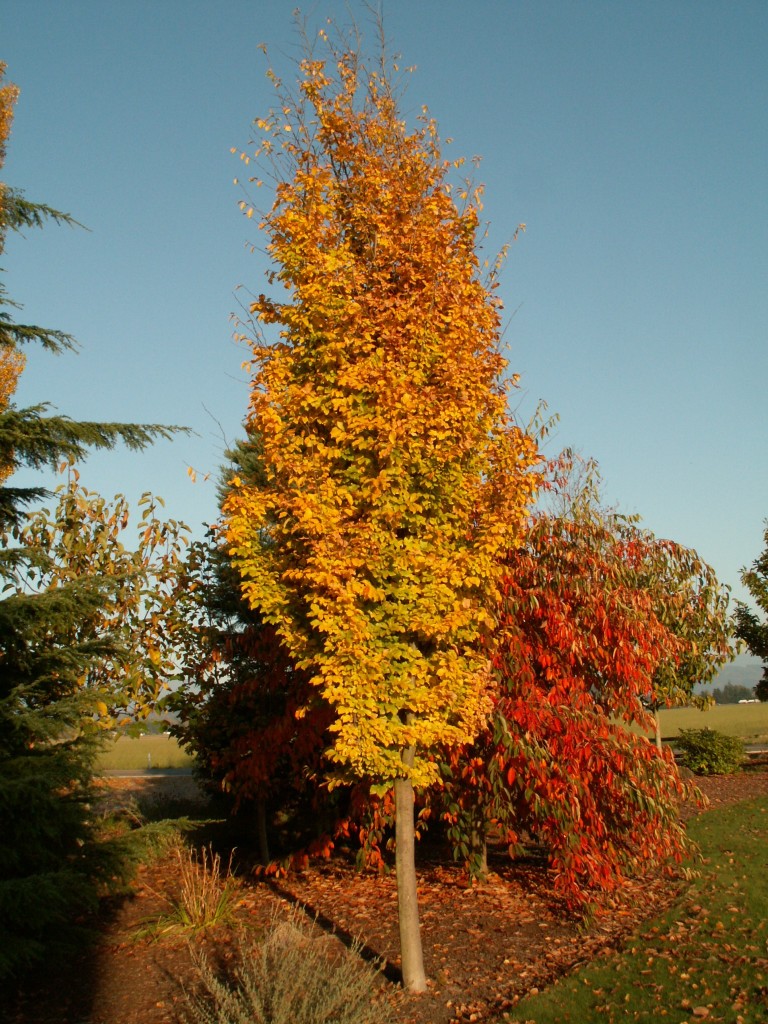
Not long ago I wrote of three Parrotia persica cultivars worthy of note for your street tree list: ‘Ruby Vase’, ‘Vanessa’, and ‘Persian Spire’. I have just come across another to add to this list, Golden BellTower™ tree. A friend and local tree grower, Ken Christianson at Chrishaven Trees in Burlington, Washington discovered this tree nearly 24 years ago; unlike many new tree varieties, this one has a pretty good history and performance record. Ken describes the ‘Golden BellTower™’ as more reliably upright and columnar than some other Parrotia cultivars. It appears to be a moderate to fast grower, reaching 30 feet tall and up to 10 feet wide in about 25 years. Many other trees claim those mature dimensions but do not always live up to them, usually growing wider with age.
If you are unfamiliar with the Parrotia, you may mistake the leaf for a witchhazel, not really a stretch since they are both in the Hamamelidaceae family. And although the straight species of Persion ironwood has been a favorite for many, it was limited for urban use because if its relatively broad and unruly form. The arrival of new Parroita tree cultivars with more reliable form like ‘Golden BellTower™’ have changed the game.
An unusual feature from the other narrow cultivars is the gold to apricot fall color, lending “golden” to its name, BellTower. It should be noted that fall color can vary considerably because of regional soils, and climate. From my experience, I have seen variations of fall color be spectacular to incredibly boring on the same tree from year to year depending on seasonal weather. This selection apparently leans towards the yellow spectrum with more reliable color each year.
Parrotia trees are disease and insect pest free. They are bullet-proof and a must have on any street tree list. Michael A. Dirr describes them as tolerant to heat, drought, wind, and cold and as one of the most reliably beautiful plants in their garden. This species is also somewhat tolerant of shade. Flowers emerge before the leaves in March. The showy parts of the flowers are the crimson stamens up to ½ inch across when fully open. Not overtly showy but quite amazing up close, a special treat before leaves emerge.
From our experience, Parrotia can be a little challenging to transplant. Roots do not appear to be aggressive or plentiful so nursery stock that is root pruned or grown in fabric growbags may have an advantage. Chrishaven Trees has the greatest number of finish stock available at this time and do root-prune most of their trees. It may be a few years before these are plentiful on the market but start requesting them now so they find their place in the landscape.
As always, let me know your experience with this tree.
CLICK HERE FOR MORE TREE PROFILES
Jim Barborinas
Owner of Urban Forest Nursery, Inc.
ISA Certified Arborist #0135
ASCA Registered Consulting Arborist #356
15119 McLean Rd.
Mount Vernon, WA 98273
jim@urbanforestnursery.com
Curious how Golden BellTower™ Columnar Ironwood performs in landscapes and urban spaces?
Here are some common questions people ask about this tree:
Golden BellTower™ has a reliably upright, columnar form with gold-to-apricot fall color, giving it a distinctive look among Parrotia cultivars. Its combination of vertical habit and vibrant seasonal color makes it an eye-catching addition to landscapes and streets.
This tree typically reaches about 30 feet tall with a 10-foot spread over 25 years, maintaining a narrow, upright form that fits well in tighter urban planting spaces.
Yes — its columnar form and reliable structure make it ideal for boulevards, street planting strips, and other urban locations where space is limited but a vertical presence is desired.
Absolutely — the tree’s fall foliage leans toward yellow and apricot tones, providing striking autumn color, while its flowers in early spring offer subtle but interesting seasonal detail before the leaves emerge.
Plant in well-drained soil and ensure the tree has space to establish. While generally resilient once settled, careful attention to root handling at planting can help maintain a strong, upright form in the landscape.