

Quercus garryana
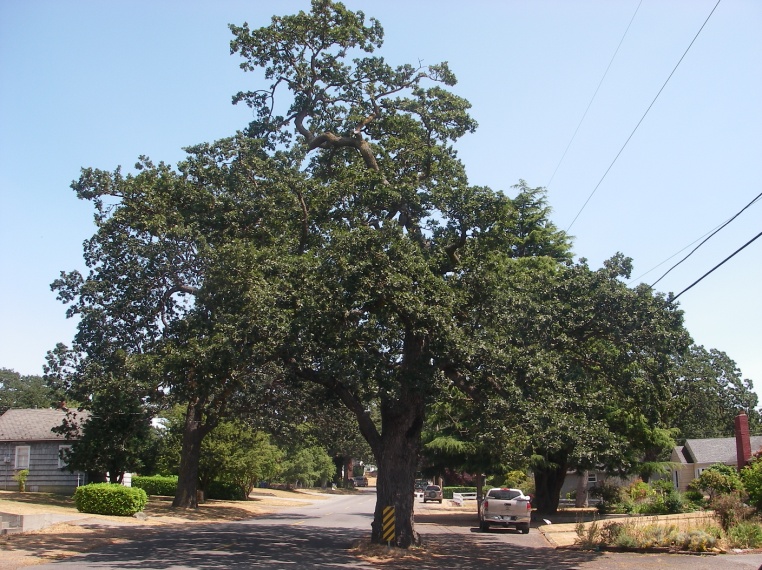
Newcomers to the Pacific North West are sometimes surprised that we have our own native oak. The first time I spotted Quercus garryana tree on the San Juan Islands, I was blown away by their size and character, particularly considering the annual rainfall there. They can get huge. And oh my, can they have character! Most of our first memories of those trees are of crooked, gnarly, bending, twisting trunks and limbs, each tree a unique work of art. That quality is also why growing them in production as street tree specimens can be especially challenging.
But the demand for Garry oaks for parks and street trees is on the rise, as so many are being cut down for development. Many cities and towns that recognize these native oaks as icons of their city are trying to save what they have and are looking to plant a new generation. However, establishing new Garry oak trees has it challenges.
First, they can be stubborn to transplant as they generally have just a single or few taproots and minimal fibrous roots when young. Move them as seedlings, and they die, go into suspended animation, or slowly take hold until they appear to be settled and ready for growth (which can take a couple of years). We sometimes “sweat” them, covering the entire bare root liners with plastic for a month or so before planting. This is to awaken the dormant buds and help stimulate root development. Now the fun begins. In production, the tree has little sense of a central leader, sending out multiple leaders and laterals in all directions. In the nursery, we stake and cut and prune and tie these multiple leaders, fighting this tree’s natural tendency to be crooked and sprawling.

We do find that larger Garry oak nursery stock seem to transplant well in the fabric grow bags, better than my experience with B&B or bare root stock. But don’t be careless when planting. Take care to handle all fibrous roots with care as they are the life force that keeps them alive and growing. And remember, good drainage is critical, and why they are always found in sandy well drained areas.
Give these trees room to grow, best in plazas, parks and wide medians. Once planted and established, the first battle has been won. Depending on the size and location you are planting in, you may have to carry on structural pruning and judicious staking of the leader. Do not prune until you know the tree is established and vigorous. Otherwise, you may kill it or the central leader. Plan to spend some time over the first few years with corrective pruning and training.
This may be a tree to keep in mind for the future given its drought tolerance and ability to tolerate low fertility soils. Be patient with their growth in the first couple of years. Once established however, they can be reasonably vigorous.
As always, let me know your experience with this tree.
CLICK HERE FOR MORE TREE PROFILES
Jim Barborinas
Owner of Urban Forest Nursery, Inc.
ISA Certified Arborist #0135
ASCA Registered Consulting Arborist #356
15119 McLean Rd.
Mount Vernon, WA 98273
jim@urbanforestnursery.com
Curious how Garry Oak grows in landscapes and open spaces?
Here are some common questions people ask about this tree:
Its crooked trunks and irregular branching give each tree a unique, sculptural appearance. Mature limbs spread widely, making it a standout specimen.
It reaches about 50 feet tall with a 30-foot spread. Garry Oak develops a sprawling canopy with multiple leaders and lateral branches in all directions.
It transplants successfully in larger sizes, tolerates drought and low-fertility soils, and adapts to open urban spaces with enough room to grow.
Its gnarled form provides year-round structure, while acorns support wildlife. Leaf color is a deep green, and the tree’s branching pattern adds visual texture through all seasons.
Careful root handling at planting, structural pruning, and staking early on help it establish. Once settled, it grows steadily with minimal maintenance.