

Carpinus betula ‘Fastigiata’
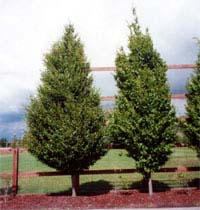
Columnar trees are becoming more popular with spaces getting smaller and tighter in our cities. One very popular variety for a long time has been the Fastigiate European Hornbeam tree. However, the name, as well as the tree, is a bit misleading. In youth, this tree is very narrow (as shown in the photo below); however, with age, the crown will widen out to as much as 25′ to 35′ wide (photo to the left). Based on Michael A. Dirr, and our experience, there can be variation within the fastigiate types. In any case, this has still proven to be one of the most dependable street and landscape trees to use. It is excellent for screening, hedges, groupings around large buildings, in malls, or planter boxes. It tolerates pruning, as well as, or better than most plants. It is possibly most distinctive with age, when planted on both sides of a planting strip or corridor. It is as if someone has meticulously pruned its crown to achieve a perfect oval-vase shape. The leaves are small and turn yellow in the fall. These are born on distinct fan-ribbed branches along dominant or co-dominant leaders.
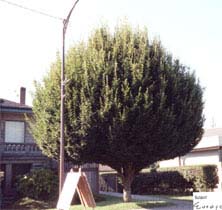
If you are looking for the ‘Frans Fontaine’ cultivar, this one is shown to the right. It is said to reach 30′ to 35′ in height and only widens out by 15′ to 18′ Except for this more narrow long term form, I have not been as impressed with the Franz Fontaine as I had hoped. As the photo shows, the Franz Fontaine, although narrow, is less uniform in outline and texture, certainly not as formal or well kept in its appearance.
Overall; however, Hornbeam trees are an excellent group of trees, with few insect and disease problems.
They tolerate most soils and most soil conditions. They transplant well and seldom show any dieback from stress. I have never seen them cause sidewalk damage, although they are planted in the smallest of spaces. They are what some of us in the industry like to call one of the “Bullet Proof Trees”. Comments on your experiences with these or other trees are appreciated.
CLICK HERE FOR MORE TREE PROFILES
Jim Barborinas
Owner of Urban Forest Nursery, Inc.
ISA Certified Arborist #0135
ASCA Registered Consulting Arborist #356
15119 McLean Rd.
Mount Vernon, WA 98273
jim@urbanforestnursery.com

This tree has been selected by Great Plant Picks for outstanding performance in Pacific Northwest landscapes.
Still curious how Fastigiate European Hornbeam performs in urban and street plantings?
Here are some common questions we hear from people considering this tree:
This tree starts very narrow in youth, but with age the crown can widen out to as much as 25–35 feet, providing more presence as it matures.
Yes — its initial columnar form and eventual structured crown make it excellent for planting strips, boulevards, and tighter corridors that benefit from vertical emphasis without overly broad spread.
It develops an “oval‑vase” shape with small leaves that turn yellow in fall, giving both subtle seasonal interest and structural appeal.
It tolerates pruning well and benefits from early structure training so it develops a balanced, long‑lived form.
Yes — its adaptability to urban soils and pruning tolerance make it a dependable landscape and street tree choice.