

Sorbus aucuparia ‘Cardinal Royal’
This tree profile is shared for educational purposes. Urban Forest Nursery does not currently grow this variety, but it remains part of ongoing discussions around urban tree selection.
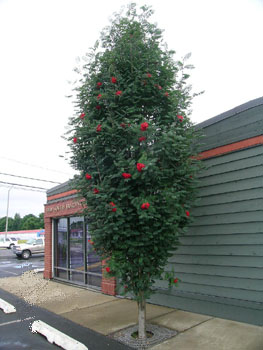
UPDATE 2026: Although an excellent tree, its challenge as a street tree is the very showy fruit. Most people just do not want to deal with the fruit that falls on the ground around the tree. We do not grow this now, but selecting them for wide planter beds, boulevards, and parks should be acceptable.
With so many possibilities in the Sorbus genus, it is difficult to decide which Mountain Ash to use. If a narrow upright form is needed, consider the Cardinal Royal® Mountain Ash tree.
This tree is readily available and is easy to grow and transplant. If you will tolerate, or should I say enjoy, some very beautiful fruit, the Cardinal Royal® is an excellent street and landscape tree. Like the majority of Sorbus, the leaves are alternate, pinnately compound, 5″-9” long, with 9-19 leaflets. Individually, they are 1″-2.5” long, oblong to oblong lanceolate, serrate along the edge, pubescent beneath – at least when young, with leaflet base asymmetric. ‘Cardinal Royal®’ is a vigorous grower with symmetrical, upright, narrow-oval form, leaves dark green above and silvery beneath, showy white flowers in spring, and with brilliant red fruit in August and September. The ultimate mature size is about 35’ tall by 20’ wide. The bark is shiny dark brown and smooth until later age. On this variety, the limbs are well attached, but strongly ascending and appearing quite narrow, especially when young.
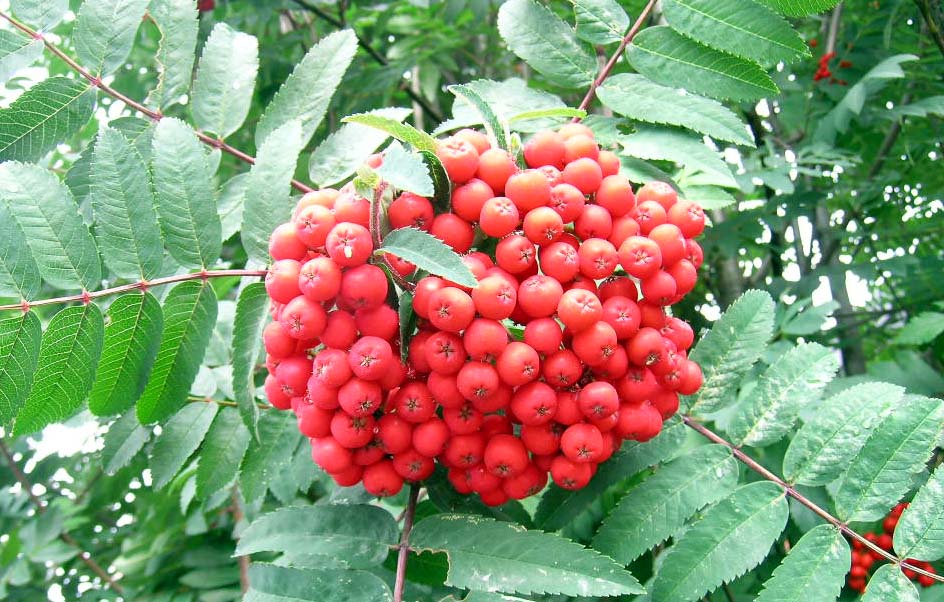
A minor downside is the heavy fruit that can pull the limbs down, disrupting the perfect upright form. In the nursery we have seen this as a short-term issue, remedied by a flock of birds that can quickly devour the fruit, with the limbs then returning upright. In our experience, we have found them to transplant easily. We have also observed a relatively small, non-aggressive, and limited root system, thus I would not anticipate them to cause any infrastructure damage.
The literature warns that stress may predispose them to canker and borer, and we have seen them struggle on poor, compacted soils. There are a number of diseases and insects that may become a problem, but primarily this occurs when the tree is weak or in a poor growing location. Like most trees, the best line of defense is to grow a vigorous healthy tree in the first place (Dirr, 1998).
Email me if you have any comment on this variety or other species used in the landscape.
CLICK HERE FOR MORE TREE PROFILES
Jim Barborinas
Owner of Urban Forest Nursery, Inc.
ISA Certified Arborist #0135
ASCA Registered Consulting Arborist #356
15119 McLean Rd.
Mount Vernon, WA 98273
jim@urbanforestnursery.com
What should I know about Cardinal Royal® Mountain Ash (Sorbus aucuparia ‘Cardinal Royal’)?
Here are some common questions we hear from people considering this tree:
This tree has many great qualities, but the heavy fruit production makes it less practical for street tree use. The fallen fruit can create maintenance concerns, which led us to move away from growing it for typical urban applications.
It has a strong, upright and fairly narrow form, along with dark green foliage that contrasts nicely with its silvery undersides. In spring it produces white flowers, followed by bright red fruit that is very eye-catching later in the season.
It grows vigorously and transplants well, with a manageable root system that is not known to cause damage to surrounding infrastructure. However, it performs best in good soils and can struggle if planted in compacted or stressful conditions.
It is better suited for areas where fruit drop is less of a concern, such as parks, boulevards, or larger planting beds. In these settings, its ornamental qualities can be appreciated without the drawbacks associated with heavier foot traffic.