

Sequoia giganteum ‘Glaucum’
This tree profile is shared for educational purposes. Urban Forest Nursery does not currently grow this variety, but it remains part of ongoing discussions around urban tree selection.
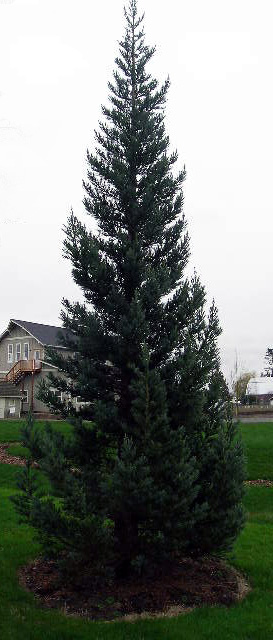
UPDATE 2026: We not longer grow this simply because it grows too fast and takes too much room. But if you want a spectacular specimen bullet-proof evergreen tree, the Blue Giant Sequoia is it. Another warning however, give it lots of room or you might end up cutting it down because it is out growing its space.
Hey, what about evergreens in the city? OK, we don’t see them much as street trees but they are planted throughout town in parks, buffers, and open spaces. Consider one of my favorites, the Blue Giant Sequoia tree, Sequoia giganteum ‘Glaucum’. Yes, most of us love the straight Giant sequoia species but you have to give it significant space to grow, or should I say, a huge space to grow. That is why you should consider the ‘Glaucum’ cultivar. It is more usable in town because it tends to be a narrower and slower growing tree than the species. I have seen a few at major intersections in the city of Bellevue. I imagine it will reach significant size eventually, but not nearly as fast, or as tall or wide. A.L. Jacobson notes the local record holder as almost 120’ tall in his 1996 printing of the ‘North American Landscape Trees’. They are native to the high elevation western slopes of the Sierra Nevada range in California but they seem to absolutely love our climate in the Pacific Northwest.
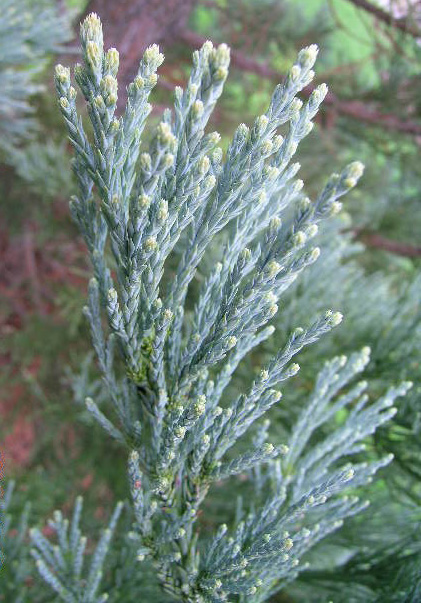
The foliage is bluish-green, seemingly bluer with establishment, sharply scaly and cord-like, and well, somewhat difficult to describe. It is best to check out the photos and confirm the species in person. Once you have seen the whole tree, you probably won’t forget it. The trunk is also huge nearest the base but still less than the species. A well balanced arrangement of limbs surrounds the tree all the way to the top, and sharply ascend upward, more-so near the tips. The form is a tall narrow pyramid, sharp and pointed at the top.
This tree appears to transplant easily and grow at a moderate rate once established. It does not sucker like the Redwood, Sequoia sempervirens. It is nearly disease and insect free, except for the Honey Fungus, according to Jacobson. Giant Sequoia ‘Glaucum’ could easily live for hundreds of years and still grow relatively large, so plan well. They are excellent as single specimens, odd numbered groups, or matching sentinels delineating property lines or outdoor spaces.
Let Me know if you have any comments on this or other trees in the field.
CLICK HERE FOR MORE TREE PROFILES
Jim Barborinas
Owner of Urban Forest Nursery, Inc.
ISA Certified Arborist #0135
ASCA Registered Consulting Arborist #356
15119 McLean Rd.
Mount Vernon, WA 98273
jim@urbanforestnursery.com
What should I know about Blue Giant Sequoia (Sequoia giganteum ‘Glaucum’)?
Here are some common questions we hear from people considering this tree:
We stopped growing this tree mainly because of its size and growth rate. Even though it’s an outstanding evergreen, it quickly outgrows typical nursery space and most urban planting areas if not carefully sited.
This tree has a striking blue-green foliage color and a strong, upright pyramidal form. It creates a very bold visual presence and tends to be more narrow and slightly more controlled than the species, making it a bit more adaptable in designed landscapes.
It establishes well, grows steadily, and has shown to be very resilient with minimal insect or disease issues. In the Pacific Northwest especially, it performs extremely well and can live for a very long time, continuing to gain size and presence over the years.
This tree needs significant space to reach its potential and should be placed where it won’t outgrow its surroundings. It works best as a specimen tree or in large open areas where its size, structure, and longevity can be fully appreciated.